

This holiday season has a new front door, and brands have less control than ever how that door looks.
Before ever seeing a product page, a growing share of shoppers now ask an AI assistant about upcoming purchases or which brand to choose. The brands that appear in those answers get chosen before ads even reach the consumer.
Adobe's holiday forecast, as reported by Relevant Audience, puts US online spending for November and December at $275.1 billion, up 6.7% on last year.
But, a second number in the same forecast deserves more attention. Adobe expects traffic to retail sites from AI chat and browser services to rise 130% year over year. And those are just the trackable link clicks we can see.
Google describes the same shift from its side. In its September update for retailers, the company said shoppers are "increasingly turning to AI to discover products, compare options, and make buying decisions."
Semrush's tracking of 400 US commercial keywords found an AI Overview on 88% of them by August 2026, up from 45.75% the previous September.
Shoppers say the same thing. Deloitte's 2026 Holiday Retail Survey found 39% now use gen AI as their primary tool for at least one holiday shopping task, though only 16% would trust it to complete a purchase.
So, what should that change for brand search and social budgets planned around last year’s Black Friday?
AI Answers come from your data, and your feed
An AI shopping answer draws from brand websites and product data you share, as well as reviews and third-party content. On Google, ads are one input among several.
Google's guidance to retailers is specific here. Merchants that adopt its core feed practices see a 5% average increase in conversions the following month as AI can better understand your offerings and make appropriate recommendations.
In Google’s testing with lululemon, conversational attributes supplied by the brand were used in relevant AI Mode recommendations 50% of the time.
Feed work is unglamorous, but it is one of the few things that still pays back inside this season.
Google has also made AI performance insights generally available in Merchant Center in the US, showing a brand's share of voice against other brands across AI Mode and AI Overviews.
If nobody on the team has opened that report, make it this week's first task.

Comparison queries should be part of the search strategy
Not a new revelation of course, but search queries most likely to signal conversion opportunities sit closest to the purchase. Users asking things like which item or brand is "best," this "versus that," product "reviews", best "under $100,” etc are seeking directional information.
A campaign built on broad category keywords meets the shopper before the decision. Comparison queries meet them during it.
We saw the value of that shift with an apparel brand recently. Moving Google budget from generic clothing keywords to long-tail product comparison and high-intent terms was part of a program that grew purchases 2x on a 15% budget increase over four months.
For Shopping campaigns, Google launched AI Max for Shopping into open beta, with text customization and Final URL expansion aimed at evolving search intent. It merits a controlled test with tight reporting.
The season is longer than Cyber Week
Cyber Week is the loudest five days of the year, but it isn't where most of the money moves.
Adobe expects Cyber Week to drive $47.5 billion online in 2026, or 17.3% of November and December spending. Last year it was $44.2 billion of $257.8 billion, which left more than 80% of holiday online spend outside those five days.
Deloitte's survey shows how wide the window has become. Shoppers expected to spend 28% of their holiday budgets before the end of October, up from 24% last year and the highest share in six years. One in four bought holiday items during June promotions, and 4 in 10 planned to shop October sales events. That early wave already happened (hopefully your team accounted for it!).
December matters almost as much as November. Respondents plan to spend 36% of their holiday budget in November and 32% in December. Early December holds $330 of the average shopper's planned spend, close to the $359 planned for late November, and late December still holds $204.
Brand ad budgets tend to follow a much narrower curve. Across $675 million in 2025 Meta spend from more than 5,000 retailers, Supermetrics found Black Friday week alone took 10% to 13% of the September through December ad budget. Spend that week ran 1.8 to 2.8 times a normal September week, and Cyber Monday week kept only 56% to 79% of it.
As advertisers pull back, the auction gets cheaper. Gupta Media's weekly data from the 2025 season shows Meta CPMs peaking at $12.48 in the week of December 1, falling 38% to $7.71 by Christmas week and bottoming at $4.93 the week after. Demand holds while competition for it eases.
Discounts follow the same pattern, which helps margin. Adobe forecasts average discounts of up to 14% in early November, 21% before Thanksgiving and about 30% during Cyber Week, then 10% to 15% through December. December buyers pay closer to full price, at roughly half the Cyber Week discount.

Category timing varies as well. Adobe expects the best online prices for toys, TVs and apparel on Black Friday, and for electronics on Cyber Monday.
Google's When to Buy Guide, built on last year's discount data across US merchants, shows fragrance offers strongest in the two weeks after Black Friday weekend, handbags in mid-December, and suitcases and tech toys in late December.
Budgets that peak on Black Friday and drop on December 1 miss these patterns and likely significant revenue efficiency.
Your media plan should account for the entire gifting season, and hold back enough to stay present through the weeks your category discounts and last-minute consumers are on the hunt.
Planning from last year's playbook carries its own risk. Heading into BFCM 2024, predictive modeling for MagBak showed that holding the prior year's spend levels could raise Meta customer acquisition cost by as much as 60%. The response was to diversify channels before the peak. Blended revenue was up 40% year over year by January.
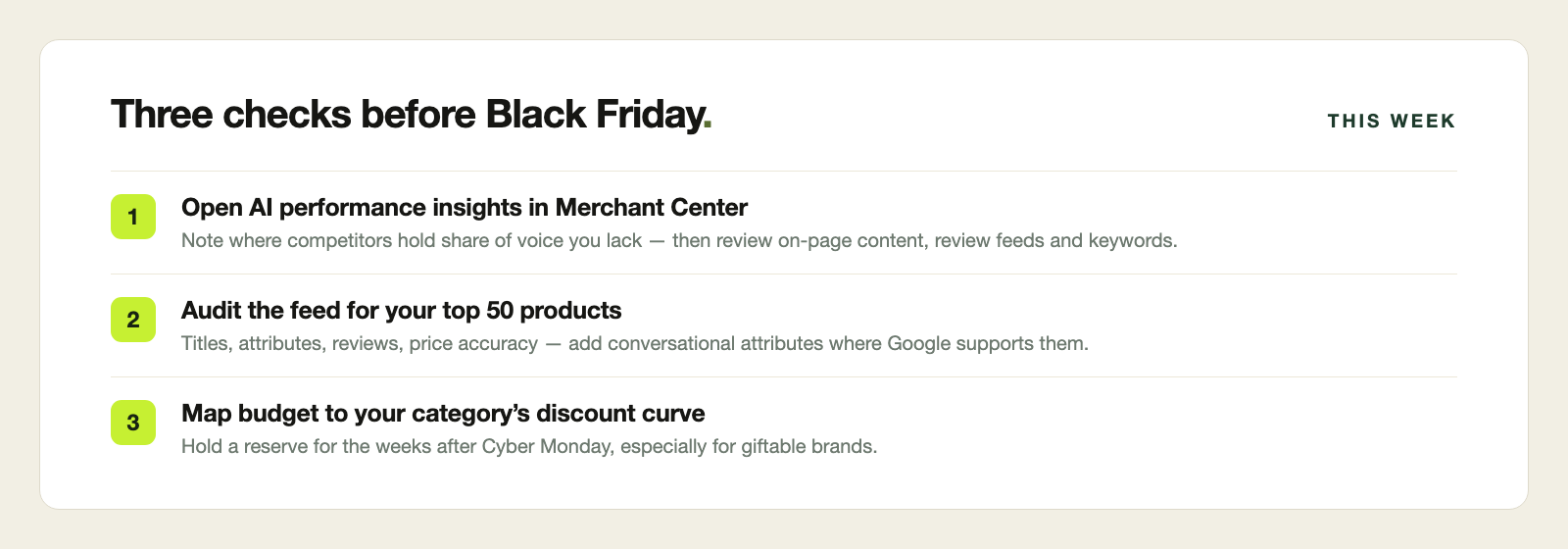
Three checks before Black Friday
- Open AI performance insights in Merchant Center and note where competitors hold share of voice you lack. Review on-page content, make sure review feeds are fresh, and audit your keyword strategies.
- Audit your product feed for at least your top 50 products: titles, attributes, reviews and price accuracy. Add conversational attributes where Google supports them, and aim to make your feed as robust as possible for both human and AI parsing.
- Map November and December budget to your brand and your category's discount curve, with a reserve for the weeks after Cyber Monday, when demand holds and CPMs fall. This matters most for giftable brands.
The shopper who asks AI for a recommendation arrives with intent. The work is making sure your products are in the answer.
Neon Growth can map your Google and Meta budget to your category’s demand curve, from feed audit through late-December gifting.
Talk to a PartnerSources
- Relevant Audience: Adobe forecasts record $275.1 billion US online holiday spend, with AI-referred traffic up 130% (October 3, 2026, reporting Adobe's September 28 forecast)
- Google: Boost your holiday sales with these agentic commerce updates (September 16, 2026)
- Semrush: AI Overviews have nearly doubled across five commercial search modifiers (October 21, 2026)
- Google: Proven tactics to drive holiday sales (September 16, 2026)
- Google: Data-backed secrets to smarter holiday shopping (October 15, 2026)
- Deloitte: 2026 Deloitte Holiday Retail Survey (October 15, 2026)
- Adobe: U.S. Holiday Shopping Season to Hit Record $275.1 Billion Online, Rising 6.7% YoY (September 28, 2026)
- Adobe: Holiday Shopping Season Drove a Record $257.8 Billion Online (January 7, 2026)
- Supermetrics: Black Friday playbook for retailers 2026
- Gupta Media: What Is Q5 in Marketing? 2026 Dates and Ad Costs
- Neon Growth: Spinn case study
- Neon Growth: MagBak case study


