Black Friday is nearly here (November 27 this year). If you haven’t checked your Meta, Google and TikTok account defaults since October, you’re probably running Cyber Five campaigns on settings you didn’t choose.
The last six weeks brought a wave of changes across the major platforms, and more of them than usual are “on by default” rather than opt-in. Here’s what actually matters before the holiday weekend, and what to do about each one.
Meta: Creative Automations Worth Checking
Meta’s Advantage+ creative tools now generate video from static product images automatically, and product browsing has been rolling onto existing ads since late October. Both are on unless you turn them off in Advantage+ creative and destination settings. If you haven’t audited which ads have these enabled, do it before traffic ramps this week.
Meta’s AI is also auto-detecting and applying discounts to active Facebook and Instagram ads through Offer Merchandising. If you haven’t set your own BFCM pricing yet, Meta’s model may set it for you based on what it finds around your website (i.e. newsletter offers). Turn off automatic offer application in Commerce Manager under Settings > Offer Merchandising.
On-device Pixel measurement started November 12, and Meta expects attribution numbers to shift through November 18 as the new method phases in. Expect more attributed purchases than you’re used to seeing. Meta’s own guidance: avoid major campaign restructuring during this window, since you won’t be able to tell a real performance change from a measurement artifact.

One more thing worth flagging to legal or brand safety before BFCM creative goes live: Meta’s planned updated Commercial Terms would make advertisers solely responsible for anything its AI features generate or alter in an ad, with no condition that you had to have opted into the feature. The effective date was pushed from October 30 to November 20, and a court, a regulator and Meta itself have all raised questions about that date since. With the date now undetermined, don’t assume that your brand is not liable for Meta’s creations.
Google: Performance Max Sees More Automations
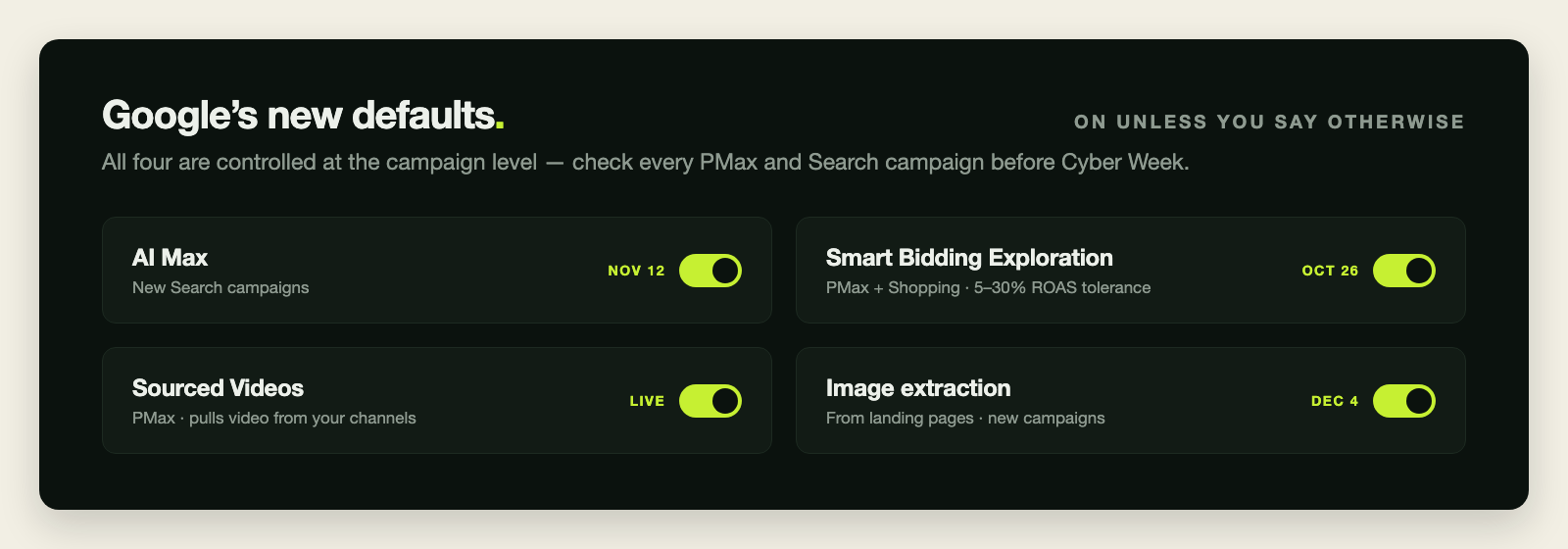
Google Ads Editor 2.14, released November 12, turns on AI Max by default for new Search campaigns. Toggle it off for each campaign to skip it.
Smart Bidding Exploration expanded to standard PMax and Shopping on October 26, giving the algorithm 5 to 30 percent more ROAS tolerance below target. Be sure to set your tolerance.
Sourced Videos, a PMax toggle that pulls video from your social accounts, landing pages and YouTube channel into ad creative, ships on by default. This also must be controlled at the campaign level, but you can specify which sources Google is allowed to source videos from.
Image extraction from landing pages also goes on by default for newly created campaigns starting December 4. Be sure to tell Google if you want this on or not, again at the campaign level. If your product pages have cohesive high quality images this could be useful, but worth checking that it’s not pulling diagrams or lower quality images from reviews or other sources.
Household income exclusion targeting is also live in PMax for most accounts. Advertisers can now check their performance by bracket and also target based on brackets.
On the bright side, new funnel-based retargeting controls can help brands build more relevant campaigns for lapsed and high value customers, as well as loyalty audiences that can receive custom promotions.
The practical takeaway is the same across all of these: Google’s defaults keep moving toward “let the algorithm decide.” If you want creative or audience control during your highest-stakes week of the year, check every PMax and Search campaign’s asset and exclusion settings now.
Microsoft Advertising: A Rebuild with Some Gaps
Microsoft rebuilt its campaign management interface on November 9 and added target-versus-actual reporting for automated bidding, plus PMax age and gender exclusions, now generally available.
But device targeting and audience exclusions (Customer Match, remarketing lists) are still in pilot, despite an October 28 post saying device targeting would reach all advertisers.
If your BFCM plan assumes Microsoft PMax has the same controls as Google’s, check before you finalize the plan.
TikTok: Profit Controls + Search Visibility
TikTok pushed hard into shopping ahead of the holiday season. GMV Max Pro and a new Growth Autopilot mode shipped inside GMV Max, and GMV Max now factors affiliate commissions, coupons and referral fees into its profitability optimization instead of treating every sale as equally profitable.
A CPM-billed TopSearch placement launched November 2, competing for the first sponsored slot on a given keyword. Brands can also now track TikTok Search impression share.
Get ready for a big week!
In other news, TikTok opened its ad network, roughly 400,000 apps, to US advertisers for the first time.
If TikTok Shop is any part of your BFCM plan, spend fifteen minutes checking on the GMV Max changes this week. The profitability-optimization shift in particular can move budget allocation without anyone on your team changing a setting.
Reddit: New Placement
Reddit started testing ads placed directly inside its own search results on November 3, matched contextually to what users are actively searching. The test runs through Reddit’s existing ad targeting rather than adding a new bidding method, and Reddit hasn’t published eligibility criteria or a timeline for wider rollout. Nothing to act on in your account yet since this is advertiser-side opt-in territory Reddit controls directly.
Snapchat: DPA Ads Are Here
Dynamic Product Ads now bring catalog ads directly into Chat conversations, part of Snapchat’s holiday Commerce Power Pack. No action needed before BFCM if your catalog is in good shape, but worth a line in your planning doc if Snap is part of your mix.
What to Actually Do This Week
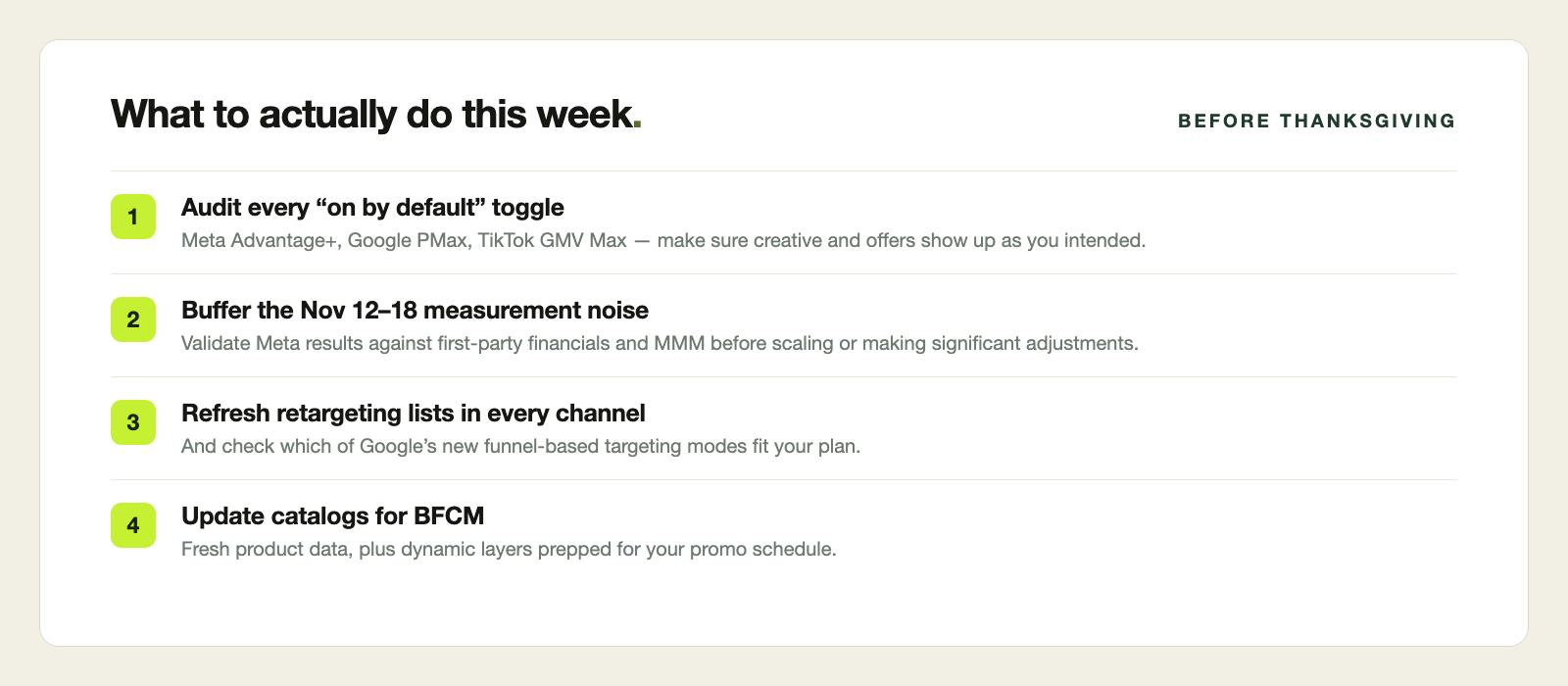
Audit every “on by default” toggle across Meta Advantage+, Google PMax and TikTok GMV Max before Thanksgiving. Once Cyber Week traffic hits, you won’t be able to tell a platform change from a performance dip. Make sure your creative and your offers are showing up as you intended.
Build in a week of measurement noise around November 12 to 18 for Meta specifically for ecommerce brands. Validate results with your first party financials and MMM before scaling or making significant adjustments this week if possible.
Update your retargeting lists in all channels, and check out which new Google targeting options are a fit.
Make sure your catalogs are updated and fresh for BFCM (and prepare dynamic layers for your promo schedule).
Neon Growth’s media team can pressure-test your Meta, Google and TikTok defaults before the holiday traffic hits.
Talk to a Partner