Google Shopping is the largest paid media inventory that has never had a real creative canvas.
It is a structural constraint baked into the platform’s design. For over a decade, every brand’s listing has looked identical: a product on white, a price, a name, a star rating.
Advertisers could optimize bids, feeds, and product data structures. They could get more reviews, or have a better price to stand out.
What they have not been able to do, until now, is differentiate visually at the shelf.
The result is a marketplace where product differentiation collapses into price parity, and the only metric that matters is the lowest cost per acquisition.
But for brands with strong design, complex products, or narrative identity, the shelf has long been a source of missed opportunity. That changed in July 2026.
Neon Growth, Marpipe and MagBak Turned Whitespace into Green
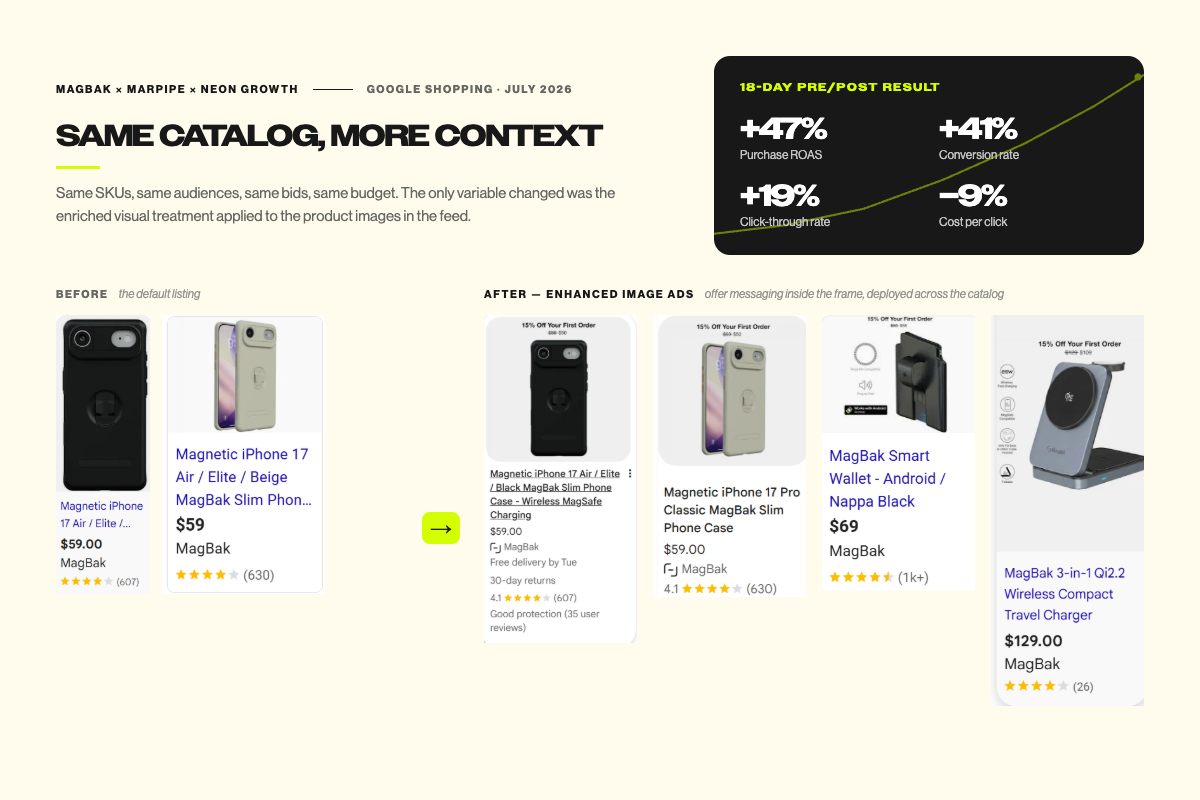
In partnership with Marpipe, Neon Growth launched the first enhanced image ads ever deployed on Google Shopping listings for MagBak, an innovative engineering-led tech accessory brand. The test architecture isolated the creative variable, and measured the impact with a pre/post control framework.
Led by Neon Growth Search Director Ackah Blay, this test was structured to isolate the creative variable as the sole material change. The experiment was not a product update, nor a new ad format. It was a structural revolution: the product feed itself became the creative canvas for the first time.
- MagBak’s core product images remained unchanged.
- The same SKUs were used in both the pre- and post-test periods.
- The same audience segments, bidding rules, and campaign settings were applied.
- The only difference was the enriched visual treatment applied to the product images in the feed.
Marpipe’s catalog creative engine generated these enhanced frames across the full SKU set, embedding offer messaging directly into the image frame in a way that preserved visual integrity and brand consistency.
Neon Growth deployed the treatment across the live Google Shopping feed, ensuring that the new images were served in real-time to shoppers in the same placements as the original. The test ran for 18 days in each phase, with the post-test period immediately following the pre-test. This pre/post control design allowed for a clean comparison of performance, with all other variables held constant.
The results were directional:
- 47% increase in purchase ROAS
- 41% lift in conversion rate
- 19% rise in click-through rate
- 9% reduction in cost per click
- all on the same budget, with the same SKUs, and no change in targeting or bidding strategy.
The test window was 18 days, long enough to capture a signal, but short enough to limit seasonal or campaign-level noise. The next phase includes extending the test to confirm durability across longer timeframes and seasonal cycles. The team is also iterating on creative treatments: testing different offer variants, dynamic pricing callouts, and lifestyle-enriched frames. The goal is to understand which types of messaging drive the highest conversion lift and which visual styles resonate most with different audience segments.
Why Enhancements Helped MagBak Stand Out
MagBak’s products are not just phone cases; they are patented with unique features and engineered for durability, all within a visually minimalist form. But on the traditional Google Shopping shelf, that narrative is invisible. The only signal is the price tag. This forces brands to compete on cost, not value, and leads to a race to the bottom in acquisition efficiency.
The commoditized shelf problem is a consequence of design constraints that have gone unchallenged for over a decade. Google Shopping’s default image format, a single product shot on white, was never intended to be a storytelling medium. It was a functional display, optimized for speed and consistency in the wild wild west days of ecommerce.
In a placement where visual cues are minimal, the only differentiators are price and rating. For brands that rely on design language, material quality, or engineering precision, the very things that define MagBak’s value proposition, the shelf offers no space to communicate their story.
The 19% increase in click-through rate indicates that the enhanced images captured more attention on the shelf. In a space where visual distinction is rare, even subtle enhancements, like a badge or a contextual callout, can break through the noise.
Shoppers were not just clicking more, they were clicking more meaningfully. The 41% lift in conversion rate confirms this. The embedded offer messaging signaled value before the click, reducing friction and aligning shopper intent with the product’s actual proposition.
This is not a case of “more clicks, fewer conversions.” It is the opposite: better clicks, higher quality traffic. The 9% decrease in cost per click further supports this. The enhanced listings attracted more relevant intent, suggesting that the visual enrichment improved signal-to-noise ratio at the shelf level.
The resulting 47% increase in purchase ROAS is a compound effect. It reflects the convergence of three forces: more clicks (19% higher), better clicks (41% higher conversion), and lower cost (9% lower CPC). The observation that all three metrics moved in the same direction, up for conversion and CTR, down for CPC, indicates a systemic shift in how the placement performs.
Our results here suggest that the Google Shopping placement still has room to optimize as a visual interface rather than a static product listing.
Ready to rethink your brand’s shopping feed?
For enterprise brands running significant Google Shopping spend, the assumption that Shopping is a “set the feed and forget it” placement is now outdated. The future of shopping campaigns is not in bidding wars. It is in visual storytelling at scale that underpins an optimized feed.
Brands with strong visual or narrative differentiation, those that have been forced to compete on price alone, have the most to gain. The playbook is repeatable: standardize the data layer, enrich the feed with brand voice and offer messaging, deploy at catalog scale, measure like an experiment.
Marpipe’s internal benchmarks show that enriched catalog ads on Meta, Pinterest, and Snap typically deliver around a 20% average lift in performance. We’ve seen similar strong results for client brands as well.
The MagBak result, a 47% ROAS increase on Google Shopping, suggests that the same physics may apply to Google, but with greater potential for amplification. Why? Because the baseline was low. The platform has been so creatively uniform that even modest enhancements generate outsized returns.
The ultimate takeaway: the feed is not just a data container. It is a visual interface. And when treated as such, it can deliver performance gains that were previously impossible. The most overlooked inventory in digital advertising can be reimagined as a creative canvas.