TL;DR for CMOs: Why Most Enterprise Brands Are Overpaying for Growth (and Don’t Realize It)
If your paid social performance has plateaued, it’s rarely a bidding problem.
It’s a creative structure problem.
Most enterprise brands are:
- Over-invested in bottom-funnel, conversion-focused ads
- Under-invested in shaping demand upstream
- Feeding platforms narrow signals that limit scale
The result is predictable:
- Rising CAC
- Increasing reliance on retargeting
- A ceiling on spend that becomes harder to break each quarter

What changes performance is not more ads.
It’s a different system.
A structured, awareness-based creative approach expands how platforms find buyers, lowers acquisition costs, and stabilizes scale.
In accounts where this is implemented correctly, the pattern is consistent growth.
Why do people make a purchase?
It’s an age-old question in business and advertising, one answered in multiple psychology and sales disciplines. If you ask 10 marketers, you’ll probably get a few different answers.
- “They liked the ad.”
- “They liked the product.”
- “They needed the product.”
- “The price was right.”
- “They’re loyal to the brand.”
- “Right place, right time.”
All have some degree of truth. Sometimes the ad alone might resonate enough emotionally to trigger desire. They might buy because the ad reminded them of a job to be done, or it solved a problem nagging at them. Maybe it highlighted a solution they didn’t know existed yet. Maybe it moved them one step closer to a decision they were already working toward with urgency.
Eugene Schwartz called this “awareness”. Most marketers are well-aware of the “awareness funnel” but the job is more than just bringing eyeballs to a brand. It's working with a viewer’s psychological state and perceptions. An ad creative either matches that state or it doesn't.
While Schwartz’s Breakthrough Advertising dropped in 1966, 50 years later, the psychological frameworks of awareness stand the test of time and are still useful for optimizing ads in the age of AI and machine learning algorithms.
At Neon Growth, the funnel architecture serves as a foundational part of creative strategy and creative diversity. Let’s talk about why, and what this looks like in practice.
For a while now, creative strategy is treated as a production problem. Make more ads. Test more hooks. Run more variations. Eventually winners will surface.
Creative briefs focus on the product, with the buyer as an afterthought or static demographic. Brands still in this cadence are likely wondering why CPAs keep climbing in the post-ML, post-Andromeda era.
Meanwhile, the brands pulling away right now are doing something different.
They're building creative programs that map to how buyers actually think at different stages of awareness. Beyond product features and promos, their ads tap into to something deeper - the psychology of decision making. At the same time, ad algorithms are also taking a similar approach.
When ad creative is built for a specific psychological state of a specific audience, an ad channel like Meta has a much more successful time matching it the right person. Compound this with strategic differentiation aiming for new reach, and the platform's delivery system has enough signal diversity to find maximum buyers across stages.
While awareness-based creative strategy isn’t new, the consequences of ignoring it have never been higher.
Why Creative Matters More in 2026 Than It Did Three Years Ago
Three forces converged to make this unavoidable. The first is how ad auctions now work, and the second is increased supply.

Machines Find Your Customers
Meta’s Andromeda retrieval system no longer evaluates individual ads, it evaluates patterns. It clusters ads that look similar, address the same persona, and communicate the same benefit into a single identifier. One cluster gets one ticket to the auction, regardless of how many individual ads are inside it. [Source: Meta Engineering Blog, Dec. 2, 2024]
When a set of ads has different formats, different emotional tones, different messages and different audience signals, the campaign is going to enter more auctions and reach more unique audience clusters.
Many enterprise ad accounts feel “stuck”. They are often not constrained by budget. They are constrained by how many distinct ways the algorithm can find buyers.
For those of you who like analogies, we can liken this to fishing. If you have one type of bait on your hook, you’re probably going to catch a narrow range of fish. If you have multiple lines out each with different bait, you’re much more likely to catch many different fish.
A brand that only runs bottom-funnel product ads, for example DPAs or discount driven statics, is generating one cluster and entering one auction repeatedly, with every impression. The platform can only engage buyers who are already close to purchasing. Most people further up the awareness spectrum likely don’t have the context to care about the sale or DPA and don’t engage, thus the ad algorithm removes them from the delivery pool.

Anyone Can Make 100s of Ads
The second force at play is ad supply. AI tools now generate creative at near-zero marginal cost. Every brand, including competitors running on thin margins with zero strategy, can produce thousands of ad variations a day. Paid social ad auctions are filling up with generic and heavily AI creative noise. Standing out is harder than ever.
Google's Information Gain updates in early 2026 signaled the same dynamic in search: content that doesn't offer a distinct perspective is increasingly deprioritized regardless of technical SEO quality. The principle holds across paid channels. Relevant, specific, psychologically precise creative wins over volume. [Source: Google Search Central Blog, Feb. 2026]
Demand Creation is Now the Bottleneck
For years, performance marketing focused on capturing demand. That worked when demand exceeded competition and platforms were less efficient
Today, the constraint has shifted. Demand capture is saturated. Demand creation is underfunded.
Most enterprise brands are not struggling to convert demand. They are struggling to generate it.
These three pressures make human-centric creative strategy the difference between a program that scales and one that plateaus.
Where Most Brands Stall
When performance plateaus, the instinct is to optimize. Test more hooks. Refresh creative. Adjust bids. But these are surface-level fixes applied to a structural problem.
The failure often isn't creative quality or even campaign structures. It's creative uniformity and treating the audience like a demographic rather than real people.

Their audience is a static one-pager.
Most creative briefs are written for the same person: The one who is ready to buy. Moreso, they talk to all versions of this one persona the same way.
This is understandable. It is also limiting. This isn't just ineffective, it burns impressions and trains the algorithm on low-engagement signals.
Customer mapping should be a 2-way exercise. Brands should routinely ask their customers who they are and confirm or shift audience perceptions.
Let’s pretend we’re working on a luxury bluetooth speaker (based on a true story). The brand’s customer template is a 20-year old male college student that likes music and has a little disposable income. This template was formed in one market, and now they’re trying to scale.
The 20 Year Old Male Student (hereforth, ‘Dude’) is an important demographic and one worth advertising to. Even within this demographic, dudes have many use cases and awareness levels. We can break out several ‘dudes’.
- Dude 1 might have a houseparty he’s hosting and he’s actively searching for a new speaker.
- Dude 2 might be interested in tailgating and unhappy with the volume of his current box.
- Dude 3 might own a small DJ business and care more about tech specs.
- Dude 4 might be a new student who wants to make friends and likes the beach, knows speakers exist but not portable ones!
While fruitful, this demographic profile also represents maybe 10-20% of the addressable market at any given time. There are multiple types of buyers at multiple stages of awareness, and multiple use cases we could be talking to.
For our example above, breaking through a growth plateau meant finding new audiences. That process involves concepting who they might be, why they would buy, and what stages of awareness they have about the product as well as the broader industry it sits in.
Who else might buy a powerful speaker? Our strategists set out to find them, and sparked multiple new creative funnels contributing to major growth. Such as, Garage Dads, Audiophiles who Like it Loud, Labor Workers, Campers etc.
The outcome? Whole new demographics unlocked (with much more buying power and room to scale.)

Their competitor analysis hasn’t been updated in years.
Marketing and brands do not exist in a vacuum, especially in the information age.
If the algorithm determines a person is interested in a category, they’re likely seeing your competitor offers in the same scrolling session as yours. It’s important to find your advantages and whitespace to develop recognition and affinity.
Creative strategy cannot ignore market intelligence and brand position. Every purchase decision is a choice between your brand and your direct & indirect competitors. We can almost guarantee your hungriest competitor is scoping your ad library weekly.
If three other brands are already running similar solution-aware messaging in your category, you should be hunting for your unique angles and targeting a different persona or benefit entirely.
Running the same pitch just adds to the noise and doesn’t differentiate you in the eye of the audience.
They treat creative testing as iteration or random experimentation.
Swap the first line, test the headline, change the background color. These micro-variations produce micro-insights. This was an effective strategy for a few years, but algorithms are no longer incentivizing minor swings.
Even in video, slightly different ways of saying the same thing (in the same setting, delivered by the same creator) are going to be treated as one ad (and one auction entry).
Today’s creative testing unlocks bigger wins by testing unique-looking ads, diverse messaging and benefits, and adapting set & setting to your persona.
Creative teams should have a clear understanding of who they’re talking to at which awareness stage and what the expected learning is before producing new ads.
Analyzing clearly targeted creative actually helps brands understand who resonates with what content at what stage in the funnel. This loop is what unlocks efficienct creative production at scale and build sustainable revenue growth.
They over-invest in the bottom funnel.
How do you know if this is you? If most of your ads are focused on sales, price, urgency, holiday promotions or DPA catalogs - you might be ignoring the upper ⅔ of your potential audience.
Bottom-funnel creative is expensive to run, but it’s easy to measure and gives the impression of strong performance. It’s most likely to get the trackable click closest to purchase.
Customers ready to buy are the most premium traffic in ad ecosystems, so they also cost a premium.
Brands that build audiences at the top and middle of the funnel earn cheaper, higher-intent audiences at the bottom over time. Brands that skip straight to the bottom pay the full market rate for buyers their competitors already warmed up.
Similar to eating cake for dinner, it gets the job done but there’s likely to be consequences when it’s your entire meal plan.
The Audience Aperture™: Applying Awareness Segmentation in Practice
Beyond theory, the purpose of using frameworks like Schwartz’s Awareness model is to provide a foundation for problem solving at scale.
The problem being solved here is using creative resources effectively and efficiently to produce ad creative that performs not only on ROI, but also on net-new growth and brand affinity.
Our creative team at Neon Growth uses a hybrid awareness model that layers in the Transtheoretical Model of behavioral change as well as several time-tested patterns and heuristics. This Audience Aperture™ framework enables creative strategists to systematically optimize for audience opportunities and diversity.
While Schwartz's original framework proposes five stages of awareness, we use six for cleaner performance segmentation. Let’s dive into what defines each group and how ads differ between each.
Awareness Level 1: Unaware
What Unaware means. This person isn’t intending on taking an action at the moment, as they haven’t realized that they have a problem to solve. They might not have recognized the issue yet, or they've normalized it to the point where it doesn't register as something to fix. They are not searching for solutions. They are not comparing options. They are scrolling.
The unaware mindstate. No urgency. No language for the problem. Some ambient awareness that something could be better, but no active frame around it. If you show them a product or promo ad, it lands as irrelevant noise.
The creative goal. Interrupt the scroll with something that mirrors their life back to them. Name the friction they feel but haven't labeled. Create recognition without a sales pitch. The conversion you want at this stage is less of a click to purchase, and more the inner thought, "that's exactly how I feel." You're planting a seed.
This is the hardest stage to brief against and the most valuable to get right. Unaware buyers make up the largest portion of any addressable market. They're the least competed-for in most categories. Getting even partial conversion from this stage creates a pipeline that shows up at the bottom months later at a fraction of the cost.
Format and approach. Native-feeling content that doesn't look like an ad is the strongest format here. Real situations, real people, real friction. A video that opens with someone recognizing a problem they didn't have language for. A before-and-after that leads with the before state, not the product. Pattern interrupts that create curiosity without a pitch.
What to avoid: product names in the first few seconds, price or offer language, anything that reads as an ad before the viewer has a reason to care.
Awareness Level 2: Problem Aware
What Problem-Aware means. The person here knows they have a problem. They’re in recognition mode, perhaps with a mild discomfort to make a change. They’re starting to contemplate the path of action versus inaction. But, they haven't yet identified what type of solutions exists, let alone which specific product to buy.
The problem-aware mindstate. Naming the frustration. Starting to search. Not yet in category-evaluation mode. Language shifts from passive ("I feel tired all the time") to active ("why am I always exhausted").
The creative goal. Validate and amplify the problem. Show them the scope of what they're dealing with. Introduce the idea that a solution category exists without hard-selling yet. The buyer at this stage responds to being understood and educated, not being sold.
Proof that the problem is real and common moves this stage better than product claims. Social proof about the problem itself ("3 in 5 adults have this issue and don't know it") is more persuasive than social proof about a product they haven't considered yet.
Format and approach. Educational content, founder stories, community content. Long-form video where the problem is unpacked. Testimonials that focus on "I didn't realize how bad things had gotten until..." rather than "this product changed my life." Native editorial formats like articles and explainer graphics that read as information rather than ads.
Awareness Level 3: Solution Aware
What Solution-Aware means. The buyer knows a category of solution(s) exists. They haven't committed to one. They're evaluating approaches: whether to handle it themselves, which type of product addresses it, what trade-offs look like.
The Solution Aware mindstate. Comparative. They're reading reviews of categories, not just products. "Best supplements for energy" not "Brand X reviews." They want to understand the solution space before narrowing into brands.
The creative goal. Position your approach as the right type of solution. This is where mechanism matters. Not "we help you sleep better" but "unlike [common approach], which does X, we do Y because Z." You're not selling the product yet; you're selling why your approach is the right one.
Format and approach. Comparison content, explainer videos, "how it works" formats. Founder credibility pieces that explain the philosophy behind the product. Testimonials from people who tried other approaches first and explain why this one worked when others didn't. The message is "you've found the right category, here's why ours works."
Avoid leading with a promotional offer or discount at this stage. Price-sensitivity hasn't been established yet. The buyer's question is "is this the right kind of thing" not "is this the right price."
Awareness Level 4: Product Aware
What Product-Aware means. The buyer knows your product category exists. They still haven't bought yet. They're in consideration mode, comparing alternatives, checking reviews, assessing risk, looking for the thing that tips them over. They haven’t encountered your brand yet, though.
The product aware mindstate. Objection mode. They've done enough research to have specific doubts: Is it worth the price? Will it actually work for me? What's the catch? What do other people say? This stage is about reducing friction vs creating awareness.
The creative goal. Handle objections and competition. Specifically. "I was skeptical about X" testimonials. Comparison against alternatives they've likely already evaluated. Proof that addresses the three or four most common reasons people hesitate before buying.
This is where social proof does the most work but the specific type matters. Generic five-star reviews do less than specific outcome stories from people who look like the buyer and had the same doubts or hopes.
Format and approach. UGC testimonials with authentic moments built in. Comparison ads. Review-forward content. Free trial or low-risk offer framing. FAQs turned into creative. Retargeting ads that address the specific objection signals.
Awareness Level 5: Brand Aware
What Brand-Aware means. They know the product and your brand. They want it. Something is stopping them from buying right now. Usually price, timing, or inertia.
The brand aware mindstate. Ready, somewhat informed. Needs a reason to act now rather than later.
The creative goal. Create urgency without desperation. Solve lingering questions or frictions. The buyer likely needs a little more convincing about the product or they need permission to buy today. Limited-time offers, inventory signals, bundle incentives, and free shipping thresholds all serve this function. So does social proof that signals "lots of people trust this brand,” or “lots of people are buying this right now".
Format and approach. Tight, short, offer-forward. This is the ad most brands already over-index on. Dynamic product ads, retargeting carousels, direct response with a clear offer and a clear CTA. Copy can be minimal because the audience here already knows what they're looking at.
The failure mode at this stage is over-discounting and training buyers to wait for a deal. Brand and product should still do most of the work, with offers like free shipping and discounts playing supporting roles.
Awareness Level 6: Customer Retention
What Customer Retention means. They bought. They're in the product experience. The clock is running on whether they become a repeat buyer, a referral source, and a genuine review.
The customer retention mindstate. Evaluating. Using the product and matching the experience against what was promised. Either confirming the purchase was right or building toward regret.
The creative goal. Reinforce the decision. Email and SMS should surface outcomes and offer helpful tips to improve user experience. Create community. Prompt reviews and referrals at moments of peak satisfaction. Cross-sell into adjacent needs at the right time.
This stage is underused by most brands because retention creative doesn't get the same incremental fanfare as acquisition creative. The value shows up in LTV, repeat purchase rate, and referral volume. It’s what creates the strong recurring revenue successful brands are built on, and makes every new top of funnel investment yield ROI.
Format and approach. Educational content about getting the most from the product. "Results at week X" timing sequences. Community content. Complementary product introductions at the right time. Loyalty-oriented messaging that treats them as a known customer, not an acquisition target.
The Full Funnel Picture
Creative Evolution: Closing the Loop
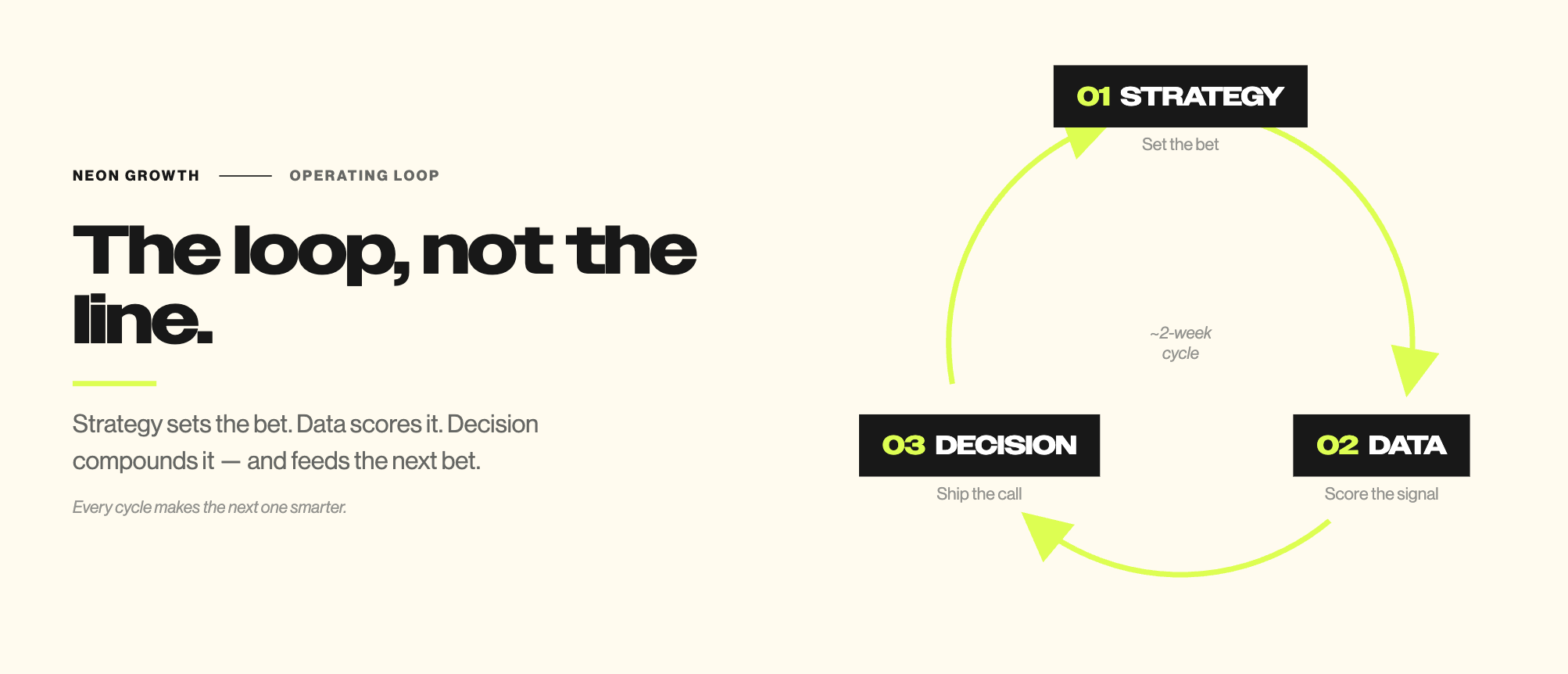
Better creative strategy is one part of success, but it doesn’t end when the ads ship. The program only improves if you build a system that surfaces what worked and why.
Effective programs:
- Ground messaging in real customer language and behavior
- Map that messaging to distinct awareness states
- Build creative designed for each state
- Test systematically, not randomly
- Feed structured signals back into the platform
Structured Testing
Variables being tested should be cleanly mapped per creative. This sounds obvious but almost no one does it.
Is this an iteration or net new? Are we transforming a winning static hook to a UGC video? Are we testing a winning UGC concept with a different creator? Are we trying a new persona territory? Is this a launch, a promotion, evergreen? What stage are we speaking to?
Knowing these answers determines where a creative lives, how it should be tested and what learnings might be drawn.
Budget allocation for testing: a practical floor is 2x CPA per concept before drawing conclusions. If you're running 20 new concepts at $500 per week and your CPA is $50, none of them get enough signal. Start with five to eight new concepts per cycle. Let them gather data. Then scale or cut.
Ad Naming Conventions
This is the unglamorous part that most agencies skip and then regret. Ad naming conventions are the spine of ad analytics. Without it, you can see that something worked. You can't see which stages, which formats, which message angles, or which audiences drove results in aggregate easily, however.
A functional ad-level naming structure might look like this:
[Date]_[Product]_[Stage]_[Format]_[Angle]_[Audience]_[Environment]_[Promo]_[Version]
Example: AW2026_WhiteSneaker_SOL_VID_BTS_CoolKids_Outdoors_V2

That tells you immediately: a video ad targeting a solution-aware buyer around the "back to school" angle, running to ‘cool kids’ persona in an outdoor setting, second iteration. When you pull performance data, you can filter by stage, by format, by angle without opening each ad individually.
The payoff: over time, you can answer "which awareness stage generates the lowest CAC" and "which angles win at problem-aware but lose at solution-aware" from a filtered data view in under five minutes. You can see which audiences are responding to which stages and ideas, and what areas need attention.
Conducting Creative Analysis
The right questions to ask after each test cycle:
By stage x audience: Where is CAC lowest? Where is CPC lowest relative to downstream conversion value? Where are you under-invested relative to your addressable market? At which awareness stage does engagement cluster? Any anomalies in conversion rates?
By stage x format: Which format generates the most downstream purchase behavior, not just the most clicks? UGC videos often win on engagement but may underperform on conversion at top of funnel. Static images may win on purchase rate at a higher CPM lower funnel. Know the full journey.
By stage x angle: Which problem framing or message angle generates the best signal ( high hook rate, high watch time, high save/share ratio) at the top of the funnel? These signals predict which angles will scale at the bottom.
By touchpoint x frequency: Are there significant differences between performance across channels for different audiences or funnel stages? At which stage does retargeting add measurable lift? (At fully-aware, the answer is almost always yes. At unaware, narrow retargeting may not be of utility yet).
The Scale/Iterate/Retire Decision
After each ~2-week test cycle, every ad gets a verdict.

Scale: CAC is at or below target, signal looks clean, no obvious fatigue. Scale budget and monitor for 7 days. If performance holds, it's a proven winner. Move it into your control creative set and start testing iterations.
Iterate: The concept has a signal worth chasing (high hook rate, good watch time, early conversion data that looks right directionally) but something is suppressing performance. Assess what should change, whether its a tighter CTA, a different URL, different script or even a different awareness stage.
Retire: Poor signal across the board, or good signal but CAC is too high to justify scaling. Document why you believe it underperformed. Was it the wrong stage for the audience? The wrong angle for the format? That documentation is the institutional knowledge that makes the next test cycle faster.
The most common mistake at this step is keeping ads with proven underperformance running too long. Brands also need to be feeding the creative engines regularly. Creative fatigue is real. Even a winning concept degrades within 6-8 weeks. A mix of iterations on learnings and new testing maintain stability while targeting audience growth [Source: Meta Ads Manager performance benchmarks, 2025]
A Full-Funnel Example in Action
To make this concrete, here's how we would apply the Audience Aperture™ framework to build a creative program for a hypothetical DTC apparel brand, selling premium women's activewear.
Foundations: Understand the TAM, Competitors & Audit
VOC audit surfaces language like: "I just wear whatever fits, I gave up on cute workout clothes after having kids," "I've tried a few brands and the quality never holds up after washing," "I didn't realize how much what I wear actually affects how I show up at the gym."
Competitive audit shows the category is saturated with product-aware creative: fabric technology claims, comparison ads against Lululemon and Alo, and promotional pricing. At the other end of the spectrum is purely fashion imagery with no branded identity. Unaware and problem-aware stages are almost entirely absent. Nobody is speaking to the woman who hasn't yet connected her workout consistency to how she feels getting dressed for it.
Creative audit of the account shows 70% of spend in product-aware and brand-aware stages. Two creative concepts account for 80% of impressions. No unaware stage creative in the account.
New Creative Brief: Motivation Angle / Procrastinator Persona
| Stage | Core angle | Format | Hook |
| Unaware | “You're not unmotivated. You just don't have clothes you want to show up in.” | 15s Reel | Woman staring at her gym bag on the floor, frumpy gym gear. Outfit change > out the door with a smile. No narration. |
| Problem Aware | “I kept skipping the gym. Turns out it wasn't laziness.” | 60s UGC video | Relatable friction, no product mention for first 12 seconds. Focused on confidence to action behavior change. |
| Solution Aware | “Why 'performance fabric' misses the mark for most women” | Educational carousel | Category education, fit-and-feel mechanism first. Designed for how you move, specific sports and max comfort through confidence. |
| Product Aware | “I spent $200 on leggings that pilled after three washes. So I was skeptical.” | 30s UGC video | Objection-first, outcome-second. Show and tell. Product in action in lifestyle setting, layering in social proof. |
| Fully Aware | “Shop confidently. Free shipping on your first order, and free returns.” | Static DPA | Offer-forward, friction removal |
| Retention | “Week 4 is when it clicks. Here's what customers tell us.” | Email sequence + retargeting | Outcome reinforcement, community signal, showing the promised outcome (ie showing up more, the fits building the confidence up, fulfilling loop) |
What does this look like after 90 days?
Unaware and problem-aware CPMs come in below product-aware stage. The creative pool competing for a woman who doesn't yet know she has a problem is dramatically thinner than the pool competing for her purchase. This unlocks more reach at the same budget
Fully-aware CAC drops because buyers arriving at bottom-funnel creative have had prior exposure to the brand narrative. The DPA doesn't have to do the whole job anymore.
Distinct creative clusters in the account grow as stage diversity, format variety, and persona differentiation generate separate identifiers in ML ad systems. More clusters, more auction entries, more unique reach.
New persona territories open mid-cycle: postpartum women returning to fitness, women training for their first half marathon, women buying for a reset after a major life transition. None of these were in the original brief. All surface through engagement patterns on unaware-stage and propel new rounds of creative strategy forward.
The Program, Not the Campaign
The biggest shift in how to think about creative strategy is duration.
High-performing organizations no longer think in campaigns. They think in systems. A campaign has an end date. A marketing program doesn't.
The goal isn't to find a winner and run it until it dies. The goal is to build a machine that continuously surfaces the message each stage of buyer needs to hear, tests refinements, retires what no longer works, and compounds learning over time.
The brands that do this well have a rhythm. New concepts per awareness stages per month, across multiple personas. Weekly analysis against the scorecard. A clear decision framework for scale, iterate, and retire. A naming convention that turns a spreadsheet of ad data into a searchable knowledge base.
That knowledge base is the actual asset. After 12 months of structured creative testing across all six awareness stages, you don't just have winning ads. You have a documented picture of how your buyers think, what language moves them at each stage, which formats earn attention versus action, and which angles have run their course.
Meanwhile, brands operating creative campaigns the old way just have a few pretty ads and higher CPMs to show. They can buy more impressions. They can't buy your understanding of your buyer.
Build the creative program built for scaling in today’s world.
Why Most Teams Struggle to Execute This
This is not a knowledge gap. Most teams understand the concept. The difficulty is operational.
It requires:
- Structured testing across multiple dimensions
- Consistent creative production at scale
- Stage-level performance analysis
- Alignment between creative and media functions
Most organizations are still designed for campaign execution. This is why performance often plateaus at scale.
Not due to lack of effort, but due to lack of system design.
Diagnosis: Where Is Your Constraint?
If your program shows the following patterns:
- Rising CAC with stable engagement
- Heavy reliance on retargeting
- Limited ability to scale spend without efficiency loss
- Creative testing focused on surface-level variations
The issue is unlikely to be execution.
It is more likely structural.
Specifically: An over-concentration of creative and spend in late-stage awareness.
If You’re Evaluating This Internally
The most useful next step is not a campaign change.
It is a clearer picture of your current structure.
- Where is your creative over-indexed?
- Which awareness stages are missing entirely?
- Where are you overpaying for demand?
That clarity is where meaningful growth decisions begin.
If helpful, we can map your current program against this model and identify exactly where the constraints are.
Talk to a PartnerSources
- Schwartz, Eugene. Breakthrough Advertising. Boardroom Books, 1966 (reprinted).
- Meta Engineering Blog. "Meta Andromeda: Supercharging Advantage+ automation with the next-gen personalized ads retrieval engine." Dec. 2, 2024. engineering.fb.com
- Google Search Central Blog. "Discover and core updates." Feb. 2026. developers.google.com
- Meta Ads Manager. Creative performance benchmarks. business.facebook.com, 2025.
- Gallup. "AI Use at Work Rises." Workplace research, Q3 2025. gallup.com