.png)
Most ad platform updates mean small tweaks for media teams. A new campaign type. A renamed objective. Shuffled dashboard. You skim the news and get back to work.
But, what Meta has been quietly publishing since late 2024 is no minor update. It’s a full system rebuild.
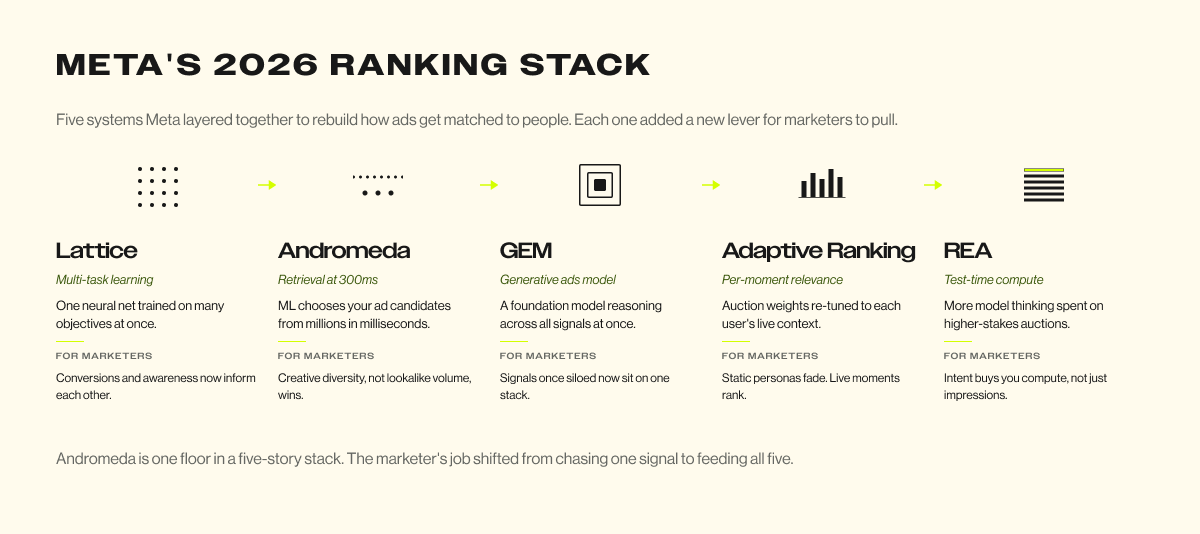
Andromeda. GEM. Adaptive Ranking. REA. Four engineering launches across 16 months, each framed as an infrastructure improvement. Read any one of the Meta Engineering blog posts and it sounds like a technical changelog. Read them in sequence and you see something else: the systematic dismantling of how the ad auction actually works, and its replacement with a machine aiming to run itself.
The surface still looks familiar. Campaigns. Ad sets. Creatives. But the machine underneath is a new beast.
If you're running significant spend on Meta, this is the most consequential change since iOS 14 privacy updates. These changes alter how media delivery works and hold important impacts for creative teams as well.
The Engineering Constraint Behind Everything
When a user opens Instagram, Meta has roughly 300 milliseconds to decide which ad to show next.
> Less than the blink of an eye.
> To choose from billions of active ads.
> Billions of times per day.
Running a full auction on every available ad (calculating estimated action rates, predicted conversion probability, competitive bids, eCPM) is computationally impossible at that scale and speed. The numbers are hard to scale.
So Meta's engineering team split the delivery system into two stages.
Stage 1: Retrieval. Scan billions of ads and produce a shortlist of roughly 1,000 candidates. This happens in milliseconds.
Stage 2: Ranking. Run the auction on the shortlist. Pick the winner.
Every system Meta has announced since late 2024 improves one or both of those stages. But, the strategic consequences of that split go beyond server efficiency.
It's the reason creative diversity now beats manual targeting precision. It's why 500 similar ads can deliver worse results than 10 distinct ones. And it's why manual audience restrictions are increasingly a liability.
The delivery architecture is now the strategy. Everything else follows from it.

The Ad Supply Problem
There's a second force accelerating this shift, and it runs from a completely different direction.
AI-generated creative is now cheap - anyone can make thousands of ads in a day. Meta's own creation tools generate assets automatically. The supply of ads is approaching infinity.
Unlimited ad supply creates an immediate platform problem, though. If most impressions are low-quality, generic, AI-generated ads, user experience collapses and so does the value of the inventory. The platforms lose what they're selling.
Meta’s response is already inside the new ranking systems. GEM is designed to understand nuanced interactions between user preferences and ad content. Adaptive Ranking models a user's "context and intent" at trillion-parameter depth. These systems also serve as quality filters built to surface the specific over the generic.
An ad that precisely matches user intent, presents a novel angle, and communicates a clear and distinct benefit will beat a generic variant at the same bid. Not because the platform is rewarding creativity as a virtue. Because the system has learned that users perceive relevant ads as better, and better outcomes keep users on the platform.
Creative quality becomes an auction input that now determines whether your ad gets selected and for whom.
Inside The New Meta Architecture
Lattice (2022-2023): The Persona Mapping Foundation
One of the first fundamental shifts in ad delivery was seen in the launch of Lattice. This signaled Meta's move from rules-based targeting to deep learning at scale. With Lattice, the system started matching ads to users based on thousands of behavioral signals instead of the declared audience attributes advertisers had been honing in on for years.
Most people observed this as interest targeting becoming less predictable. What was actually happening was Meta's system was getting better at ignoring what advertisers specified and paying attention to what users actually did instead.
Lattice considers what users engage with across all of the surfaces Meta data touches. Beyond interest targeting, the goal is understanding intent and preferences.
That shift established the operating principle every subsequent update has extended. The machine has a more accurate picture of who should see your ad than any audience you can build manually. You can disagree. But, you can no longer override it.
Andromeda (December 2024): The Gatekeeper
Andromeda is the retrieval system Meta deployed in late 2024 to filter billions of ads down to the roughly 1,000 candidates that reach the auction for a user’s eyeballs. It may be the single most consequential change to ad delivery in years.
The filtering mechanism uses a hierarchical tree structure built on semantic similarity, user intent signals, and social proof (likes, comments, shares, engagement history).
Andromeda's job is to whittle the universe of eligible ads down to a manageable candidate pool before the auction runs. [Source: Meta Engineering Blog, Dec. 2, 2024]
Here's the part that breaks the traditional playbook.
Andromeda clusters ads that look similar, sound similar, or address the same customer problem using the same visual language. It assigns each cluster a single internal identifier called an Entity ID.
The purpose of the Entity ID is to make it easier for the systems to classify ads and match them to buyer personas, buyer intent stage, and user content preferences.
If your ads all appear to target the same persona, intent stage, and look visually similar, that’s likely just earning you one Entity ID.
One Entity ID means one ticket to the Stage 2 auction, regardless of how many individual ads are inside it.
This is where one of the big strategy shifts comes into play.
The old approach: Aim for volume. Create 50 or 100 variations of a winning creative: change the hook, swap a word in the headline, adjust the background color. Let the algorithm sort winners from losers.
Why it no longer works: Those 50 variations almost certainly collapse into 1-2 Entity IDs. You aren’t running 50 experiments. You're running one experiment, and likely only see 1-2 of those ads get meaningful spend.
The Andromeda approach: Aim for diversity. Create 2-5 ads with distinct persona and funnel stage variance per cycle. Ensure they look visually different and encompass different ad formats and placements

The variable that matters most now is Entity ID count, not ad count.
Two ads addressing different customer problems from different visual angles generate two Entity IDs. That means 2 separate tickets to the auction. Diversity is now the delivery multiplier.
Getting genuine diversity across creatives means varying across elements like:
- Format: Static image vs. video vs. carousel vs. DPA
- Persona: Which specific customer type is being spoken to
- Environment: The physical or emotional context in the creative
- Benefit: The specific problem being solved, not just the product being sold
These means creative teams must take bigger swings when trying to find new audiences and angles to scale.
Creative signal quality is also important to understand. In today’s broad targeting environments, ad platforms use engagement patterns to match ads to audiences.
If a user doesn't understand if your ad is for them, how can Meta? When your creatives clearly speak to the intended audience, it makes it easier for the algorithm to find your matches.
So, ads should be diverse, and clear about who you’re trying to reach and why.
GEM [Generative Ads Recommendation Mode] (Q2 2025): The Brain
Andromeda distills creatives and decides what gets into the auction. GEM decides who wins it, and ensures outcomes stay relevant. GEM builds on the structure created by Lattice, making it scalable.
Meta published full technical details on GEM in November 2025, though it had been live since Q2.
It's described in Meta's own words as the largest recommendation system foundation model in the industry, trained at LLM scale across thousands of GPUs. The architecture is built on the same design principles as large language models. [Source: Meta Engineering Blog, Nov. 10, 2025]
Based on Meta’s testing, Andromeda drove 5% more ad conversions on Instagram and 3% more on Facebook Feed. In Q3, Meta improved GEM's architecture to double the performance gain extracted from each additional unit of data and compute.
What separates GEM from earlier ranking models isn't just size. It's how it transfers learning.
Earlier systems improved by direct training on their own outcome data. GEM acts as a teacher across the entire downstream vertical model ecosystem, propagating learned patterns to hundreds of surface-specific models through knowledge distillation and parameter sharing. GEM serves as the brain learning and improving outcomes across hundreds of models, together.
The practical consequence: the system's understanding of what drives conversions, across users, surfaces, creative formats, and behavior patterns, gets sharper with every impression it serves.
Adaptive Ranking (Q4 2025, Instagram): LLM Intelligence Without the Latency
Serving LLM-scale intelligence at sub-second latency, across billions of impressions daily, is not a problem solved by just adding hardware. Meta's solution, deployed on Instagram in Q4 2025, is the Adaptive Ranking Model.
After Andromeda identifies the ad candidate shortlist, ARM analyzes historic user signal richness and purchase intent signals. The goal is to determine how much compute power to assign to a given request.
Instead of running the same model complexity for every impression, it routes each request dynamically based on the user's signals.
High-intent user with rich behavioral history? The system runs deeper inference.
Low historic engagement and no recent purchase data? Less compute assigned.
The model complexity scales to the opportunity rather than treating every user with the same level of resources. [Source: Meta Engineering Blog, March 31, 2026]
The outcome: +3% ad conversions and +5% CTR on Instagram since launch. Those numbers stack on top of GEM's lifts. The model parameter count scales to O(1T), one trillion parameters, through a multi-GPU infrastructure that breaks the physical memory ceiling of single devices.
There is no manual targeting configuration that captures a trillion parameters worth of user intent modeling. That's not hyperbole.
REA [Ranking Engineer Agent] (March 2026): The System Architect
Launched in March, REA is an autonomous AI agent that runs the end-to-end machine learning lifecycle for Meta's ads ranking models.
It generates hypotheses, launches training jobs, debugs failures, analyzes results, and iterates. Human engineers provide strategic oversight rather than driving each step. [Source: Meta Engineering Blog, March 17, 2026]
First production results across six models showed 2x improvement in average model accuracy. REA doesn't necessarily improve ad performance. Its goal is to improve the models that improve ad performance, continuously and at scale. Meta's AI is now using AI to build better AI for ads.
The performance gap between Meta's system and a manually operated campaign was already growing before REA. Now the rate of that growth is itself accelerating.
What Meta Is Actually Orchestrating
Assessed separately, these new systems look like a series of infrastructure upgrades. But when we consider how they fit together as a single architectural project, a different picture emerges.
Persona mapping handled by Lattice. Retrieval handled by Andromeda. Ranking intelligence handled by GEM. Inference efficiency handled by Adaptive Ranking. Model improvement handled by REA. Each feeds the next. The loop runs without external input, improving on every cycle. This is the foundation of Advantage+.
Meta's Adaptive Ranking post describes the roadmap in plain terms: "near-instantaneous model freshness, utilizing incremental, in-place weight updates to achieve constant, real-time adaptation." [Source: Meta Engineering Blog, March 31, 2026]
Many skills that separated sophisticated buyers from unsophisticated ones for the last decade (audience architecture, placement optimization, manual bid management) are being automated at the infrastructure level.
The advertiser's role in this new system is not to configure delivery. It's to feed it.
The inputs that matter are: diverse creative, signal quality, clean conversion data, and enough budget per concept for the system to move through its learning phase.
What Changed and What Didn't
The old Meta ads system rewarded operators with deep targeting expertise. Audience architecture was built from years of test data. Manual bid management and pacing could optimize for the best inventory. Placement optimization could etch out better ROAS.
These were learnable skills that produced real performance gaps between teams that had them and teams that didn't. That edge is being closed from within Meta’s ecosystem.
What the new machine rewards:
- Creative diversity. The number of genuinely distinct Entity IDs you generate per budget cycle. This is now the primary lever on reach and delivery efficiency.
- Signal quality. Clean, consistent conversion data at sufficient volume for the model to learn from. Garbage in still produces garbage out. The system is just faster at learning it.
- Creative-audience fit. How well the creative matches the intent signals the system is reading, rather than how well it matches a manually defined audience.
- Budget patience. Enough spend per concept for each to exit the learning phase before you cut it.
This isn't a simpler job, but the judgement required is different. Sophisticated media teams are not optimizing delivery anymore. They optimize the inputs. The media buying team, the creative strategy team and martech teams must work closer together than ever before.
How to Compete in the New ML+AI Environment
The advertisers who will win in this system aren't the ones who fight the machine. They're the ones who understand what it's trying to learn and make that as easy as possible.
1. Creative Is the Main Lever We Control
If the platform owns targeting, placement, bid strategy, and delivery, creative becomes the main variable humans actually move. Because the system amplifies whatever signal it receives, the quality of that creative determines what the machine learns about your brand.
Better creative diversity means more Entity IDs, which means more auction eligibility. More auction eligibility means more diverse delivery at the same budget. More delivery generates more learning signals. The cycle either accelerates in your favor or against you based on what you put in.
Audit your active ads with this question: if you stripped every minor variation (hook changes, headline swaps, color adjustments), how many genuinely distinct concepts do you actually have?
Most accounts running 30 or more ads have 4 to 6 real Entity IDs. The rest is redundant.
A more useful creative testing workflow in 2026 looks like this:
- Build 10-15 concepts with genuine variation across buyer intent (funnel stage), ad format, persona, environment, and benefit)
- When a concept wins, create visually distinct executions of the same idea (not just copy tweaks). For example, you might test a new creator persona or turn a bold headline static into a UGC video.
- When concepts don’t win, make significant changes to keep testing vs small iterations.
- Treat aspect ratio variations as placement optimization, not creative testing. They don't generate new Entity IDs.

2. Manual Targeting = Less Efficiency
This is where experienced media buyers often want to push back most. Years of audience architecture feels like IP. Letting Meta decide who sees the ad feels like giving up control you earned.
The structural reality is that manual targeting constrains the branches of Andromeda's decision tree your ads can reach. If your creative semantically maps to a user intent cluster that your targeting excludes, you either waste impressions or the system skips the ad. You've paid to limit yourself.
Outside of legally required category restrictions, the evidence increasingly points in one direction: remove detailed interest targeting, remove narrow lookalikes, and let creative diversity do the audience work.
It’s a story we’ve seen many times. Rebuilding an account using heavy segmentation to focus on broad almost always improves net return on ad spend and incremental new reach.
3. But, Broad Reach Means Creative Does the Capture
The algorithm doesn’t decide alone which cultural moment a brand has earned the right to enter, which creative angle will resonate with a specific buyer at a specific stage, or what a winning brief looks like for a product that's never been advertised before.
The system needs creative input and audience reaction data to work. The quality of that input determines what it learns. The algorithm looks at user signals to grade ads & advertisers, so essentially ads are speaking to a target audience and ML is evaluating who responds.
As this shift unfolds, the value of an agency and in-house marketing teams are shifting toward always-on creative strategy, signal architecture, and measurement integrity. The teams that see this clearly have a significant window to reposition.
4. Campaign Architecture Should Align to How Machines Learn
The learning phase timeline hasn't changed much: roughly 7 to 14 days, or 50 optimization events, whichever lands first. What has changed is the cost of getting that wrong.
Fragment your budget across too many concepts or campaigns, and none of them gather enough signal. No signal, no learning. No learning, no delivery efficiency. A practical floor is 1-2x CPA per concept before you draw conclusions. If you're running 20 concepts on $500 a week, you're not testing 20 things. You're starving 20 things.
Start with 8-10 genuinely diverse concepts. After the learning phase, scale winners, cut losers, introduce new concepts. The goal isn't maximum simultaneous experiments. It's giving the system enough signal, per concept, to form an actual directional opinion.
5. Measurement Must Also Evolve to Keep Up
The system now models user behavior sequences spanning months. It optimizes across surfaces, formats, and touchpoints that last-click attribution never sees. Meta's Adaptive Ranking post describes modeling "long-form user behavior sequences" as a core capability of the inference layer. [Source: Meta Engineering Blog, March 31, 2026]
The gap between what last-click ROAS shows you and what's actually driving outcomes is wider than it's ever been. And it keeps growing as the cross-surface optimization layer gets more sophisticated.
Three things worth doing now:
- Track MER weekly. Total revenue divided by total ad spend. Imperfect but directionally honest in a way platform-reported ROAS isn't.
- Reconcile platform conversions against CRM actuals monthly. When that gap exceeds 25-30%, it's a signal that measurement may not be accurate.
- For spend over $1M/mo: validating media mix with an MMM partner can help determine what’s making an incremental impact. Calibration takes time but in the privacy era, modeled data is better than no data.
What Happens When You Don't Adapt
Failure in the age of ML can compound fast. Algorithmic efficiency depends on the inputs the human team gives it.
Creative redundancy wastes spend at scale. Thirty similar ads collapsing to three Entity IDs means paying for 30 ads to compete in 3 auctions. The production overhead, the management overhead, the budget allocation — all go to outcomes one-tenth of what genuine diversity would generate. At seven or eight figures of annual spend, this is a real number.
Narrow targeting cuts off delivery. Manual restrictions don't protect your budget. They cap the branches Andromeda can explore. You're paying the same CPMs to reach fewer auctions.
Last-click attribution decay is accelerating. The system optimizes across a user journey that spans weeks of behavior, multiple surfaces, and dozens of touchpoints. A single-touch metric captures the final step and misses the architecture that produced it. Budget decisions made from last click data are systematically biased toward the wrong channels and creative.
The gap isn't stable. REA means Meta's system improves its own models on an ongoing basis. Every cycle, the performance gap between adaptive accounts and static ones grows. Falling behind here isn't like falling behind a competitor. It's falling behind a system that is actively accelerating.
This Isn't Only a Meta Change
Google's Performance Max runs on the same architectural logic: ingest creative and conversion signals, handle delivery autonomously, optimize across the full inventory. The human sets the objective and provides the assets. The machine handles everything between.
TikTok's Smart+ campaign type, launched in late 2024, follows the same pattern. So does Amazon's Performance+. The closed-loop, intent-first, creative-signal architecture is the direction every major platform is moving. [Sources: Google Ads Help Center; TikTok Business Center, 2024; Amazon Ads Documentation]
They're all solving the same problem: how to improve advertiser outcomes and user experience simultaneously, at a scale where human-in-the-loop optimization is the bottleneck.
What's happening at Meta is a preview. The same transition will play out across every platform over the coming months and years.
Four Things to Do This Week
The full strategic shift takes time. These five have a short runway:
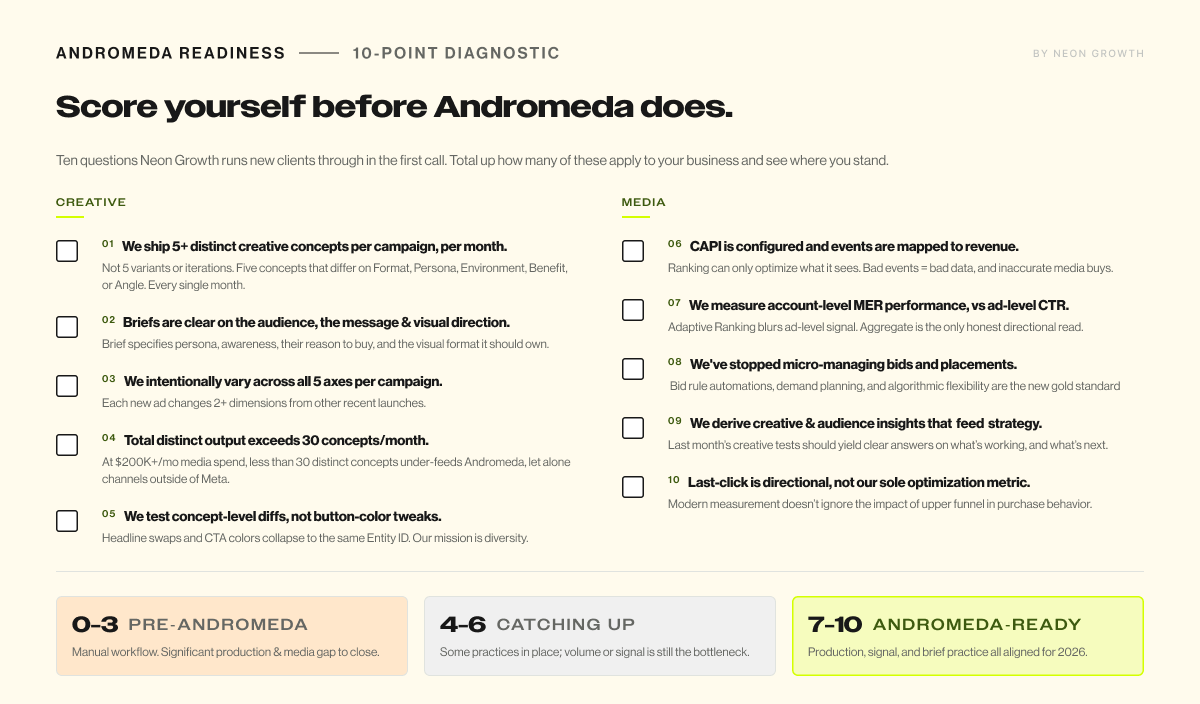
1. Audit active creatives for redundancy. Count genuinely distinct concepts (different format, different persona, different benefit, different visual environment). If you have 30 ads and fewer than 10 real concepts, that's the constraint. Strip the minor variations especially if they aren’t scaling.
2. Review audience targeting restrictions. Find ad sets where manual interest or lookalike targeting is active outside of regulatory requirements or retargeting audiences. Test removing restrictions vs adding new ones, especially on a limited budget.
3. Calculate MER for the last 90 days. Total revenue divided by total ad spend, by week. If you don't have it, build it. Especially if you do not have an MMM in place. Use it alongside platform ROAS, not instead of it.
4. Reconcile platform conversions against CRM actuals. Pull the last 60 days. A gap over 25% is a signal your optimization is working from distorted data.
The Takeaway
Meta has been working in recent years on a system that replaces most of what performance marketers used to do manually. The info shares are dense and the language is engineering-specific. Nothing in the product changelog specifically announced a strategic shift, but the shift is clearly happening.
Andromeda changed who gets into the auction. GEM changed how the auction is won. Adaptive Ranking brought the intelligence to bear at inference speed. REA closed the loop and made the whole system self-improving.
The machine is unlikely to plateau. What separates the accounts that pull away from the ones that stall is not who configures campaigns most carefully. It's who understands what the system is trying to learn and builds creative programs that give it the clearest possible signal.
That makes modern paid media primarily a problem of creative strategy and measurement.
Teams that frame it that way will adapt. The ones still waiting for Meta to announce what changed or acting as though nothing has are already behind.
Sources
- Meta Engineering Blog. "Meta Andromeda: Supercharging Advantage+ automation with the next-gen personalized ads retrieval engine." Dec. 2, 2024. engineering.fb.com
- Meta Engineering Blog. "Meta's Generative Ads Model (GEM): The Central Brain Accelerating Ads Recommendation AI Innovation." Nov. 10, 2025. engineering.fb.com
- Meta Engineering Blog. "Ranking Engineer Agent (REA): The Autonomous AI Agent Accelerating Meta's Ads Ranking Innovation." March 17, 2026. engineering.fb.com
- Meta Engineering Blog. "Meta Adaptive Ranking Model: Bending the Inference Scaling Curve to Serve LLM-Scale Models for Ads." March 31, 2026. engineering.fb.com
- eMarketer. "Meta enhances Instagram's ad targeting capabilities as it pushes toward full automation." April 1, 2026. emarketer.com
- Google Ads Help Center. Performance Max campaign documentation. support.google.com
- TikTok Business Center. Smart+ Campaigns documentation. business.tiktok.com
- Amazon Ads. Performance+ documentation. advertising.amazon.com